



AI in testing is transforming how banks approach software testing, test automation, and quality assurance. AI-powered testing tools help teams manage complexity, scale, and performance requirements in modern banking environments.
In ecosystems shaped by real time payments, API integrations, and strict regulatory requirements, traditional test automation alone is no longer sufficient. Financial institutions are increasingly adopting AI in testing to improve software quality, accelerate testing cycles, and reduce manual effort.
This guide explains how AI in testing for banks can be applied, which use cases deliver real value, and how AI-powered testing can be implemented in a compliant and audit ready way.
Further Resources
To further explore the practical applications of artificial intelligence, we have provided additional resources at the end of this article. This includes an in-depth Insight Paper and a link to our live webinar with Finextra on the “Reality of AI in Payment Testing,” offering expert perspectives on current industry challenges and solutions.
Key Takeaways
Before diving into the details, it is important to understand what AI in testing means in banking environments and where it creates measurable value.
AI in testing refers to the use of AI-powered technologies to enhance software testing and test automation, particularly in complex systems such as payments, core banking, and API ecosystems.
Typical high-value use cases include:
- Intelligent regression testing for payment and API changes
- Self-healing test automation in digital banking channels
- Automated test data generation using synthetic, compliant data
- AI-supported defect prediction and root cause analysis
To successfully implement AI in testing, banks must ensure:
- Clear governance and auditability
- Deterministic validation for compliance-critical checks
- Integration into CI/CD pipelines and existing testing processes

What is AI in Testing?
AI in testing describes the use of artificial intelligence to enhance software testing processes, particularly in complex banking environments with interconnected systems and fast release cycles.
Rather than replacing traditional test automation, AI in testing acts as an intelligent extension layer. It supports test creation, execution, and analysis while improving efficiency.
AI-Supported Test Automation vs. Testing of AI Systems
A clear distinction must be made between two related but fundamentally different concepts.
AI in testing focuses on improving software testing processes through AI-powered capabilities such as intelligent test case generation or automated analysis. In contrast, testing of AI systems refers to validating applications that are based on AI, such as chatbots or decision engines.
This distinction is particularly important in banking, where both areas coexist. While AI supports software testing efficiency, validation of AI systems introduces additional requirements related to reliability, fairness, and explainability.

Role of AI in Modern Quality Engineering
- Within modern quality engineering, AI in testing plays a key role in enabling continuous testing and integration into CI/CD pipelines. As development shifts toward faster and more iterative delivery models, testing must keep pace. AI-powered capabilities help teams improve test automation and reduce manual effort. They support earlier testing in the development lifecycle and enable continuous validation throughout deployment and operation.
- Typical contributions of AI include:
- Supporting test case creation during development
- Optimizing regression testing in pipelines
- Analyzing test results to identify patterns and risks
- This enables teams to focus on critical quality decisions.
What AI in Testing is not
Despite rapid progress in AI, it is important to set realistic expectations.
AI in testing is not a replacement for structured quality assurance processes. It does not eliminate the need for governance, nor guarantee correct results. AI systems operate probabilistically, generating outputs based on patterns rather than deterministic logic.
This is particularly relevant in banking, where every test result must be explainable and auditable. As a result, AI in testing should be used as a supporting layer, not as the final authority.
CASES
Typical Banking Test Landscapes
Banking systems are among the most complex environments in software testing. They consist of interconnected layers, each with its own testing requirements.
- These typically include:
- Frontend channels such as mobile and web banking
- Core banking systems handling transactions and accounts
- Payment infrastructures including instant payments and ISO 20022
- APIs connecting third-party services and open banking ecosystems
- AI in testing helps manage this complexity by improving data processing, test automation scalability, and software testing coverage across these layers.
Why does AI matter in banking test environments?
The relevance of AI in testing is particularly high in banking due to technical complexity and regulatory pressure.
Complex End-to-End Processes
-
Many banking processes span multiple systems and require precise coordination. Payment flows, onboarding journeys, and credit approval processes involve numerous validation steps and dependencies.
Testing these processes manually or with traditional test automation is time consuming and error prone. AI in testing helps identify critical paths and optimize test execution.
Regulatory Requirements and Compliance
-
Banks operate under strict regulatory frameworks where accuracy and traceability are non negotiable.
Every software testing process must provide:
• Clear documentation
• Reproducible results
• Transparent logic
AI-powered testing must support these requirements rather than undermine them.
Increasing Release Cycles
-
With the rise of digital banking and APIs, release cycles have become shorter. New features, integrations, and updates are deployed continuously.
This creates a need for faster and more scalable test automation and AI testing approaches, which reduce manual effort and improve efficiency.
What are the challenges?
-
Traditional test automation has limitations in modern environments. Maintaining large test suites, dealing with flaky tests, and adapting to frequent changes can become overwhelming.
AI in testing addresses these issues by introducing:
• Adaptive test execution
• Automated maintenance
• Data-driven decision-making
Banking Use Cases for AI Test Automation
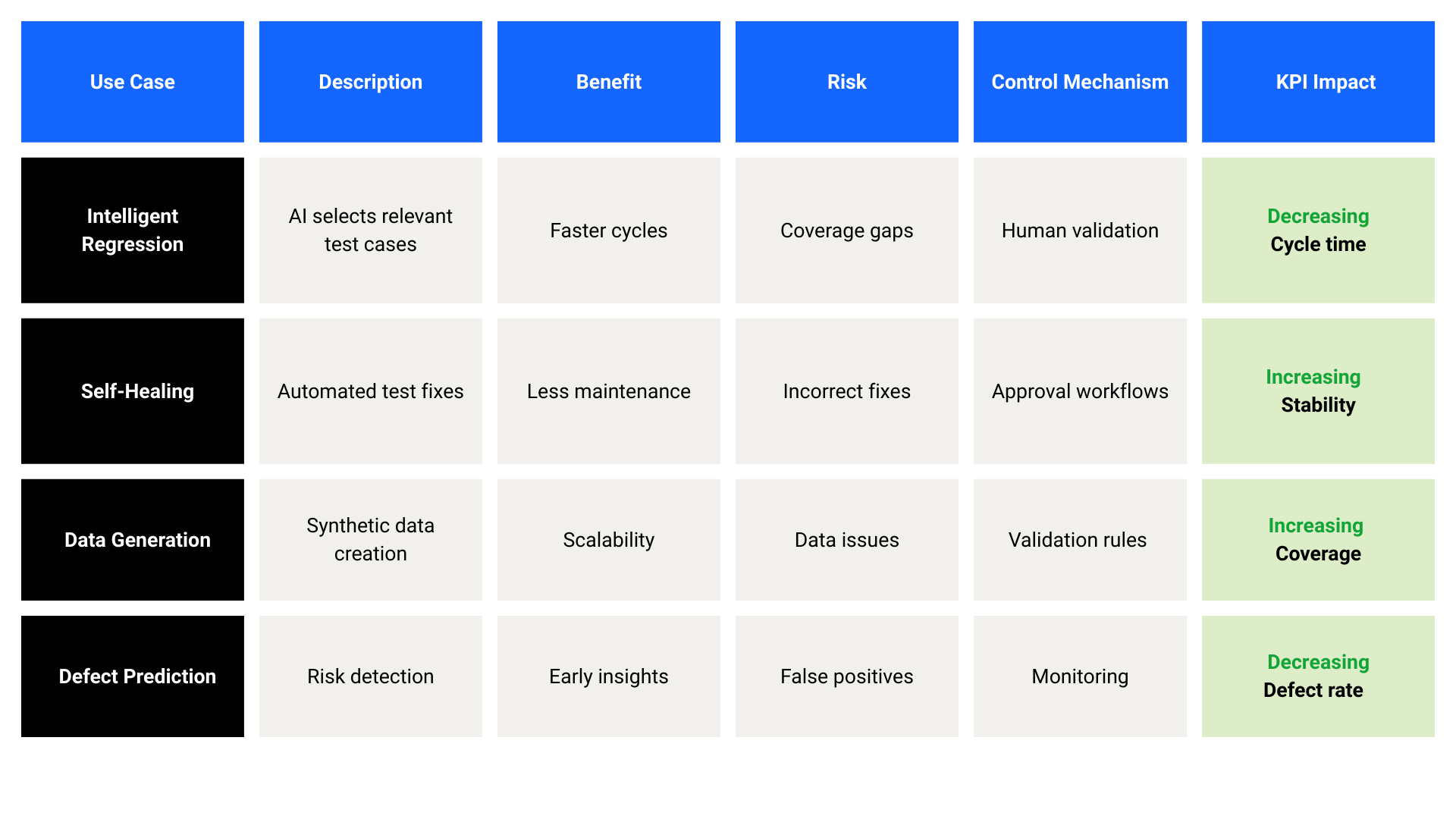
AI in testing delivers the most value when applied to concrete use cases. In banking, these use cases are tied to high complexity processes such as payment flows, onboarding journeys, and credit decisions.
Intelligent Regression & Test Case Selection
In banking, regression testing is challenging because system changes, such as updates to payment formats or APIs, can affect dependent processes.
AI in testing enables a targeted approach by analyzing changes and prioritizing relevant test cases. Instead of executing full test suites, only high risk scenarios are tested.
Self-Healing Mechanisms in UI and Channel Testing
Frontend-heavy systems, such as mobile banking or onboarding applications, are highly sensitive to small UI changes. Traditional test automation often breaks in these scenarios, leading to high maintenance effort.
AI-powered self healing mechanisms detect changes in UI elements and adapt test scripts automatically, improving test automation stability.
Compliance Checks & Audit Validation
In regulated environments, testing must also ensure compliance with internal and external requirements.
AI can support this process by interpreting rulebooks, analyzing test results, and highlighting inconsistencies. However, final validation must always be performed by deterministic systems to ensure auditability.
Defect Prediction & Root Cause Analysis
AI in testing can analyze historical test results and system logs to identify patterns that indicate potential defects.
This enables teams to move from reactive debugging to a more proactive approach, where risks are identified earlier in the development cycle. As a result, defect leakage into production can be reduced.
Automated Test Case and Test Data Generation
The generation of test cases and test data is one of the most resource-intensive tasks in software testing. In banking, this is further complicated by regulatory requirements around sensitive data.
AI-based and AI-powered testing approaches can generate realistic and compliant test artifacts, including:
• Synthetic, PII-safe test data for secure software testing
• Additional test cases derived from requirements and data patterns
• Edge cases that improve coverage in complex banking scenarios
This allows teams to increase test coverage while remaining compliant with data protection regulations.
Testing AI-powered systems therefore requires a combination of functional validation, scenario-based testing, and continuous monitoring to ensure reliability in regulated banking environments.
Testing AI-Powered Banking Systems
As banks increasingly adopt AI-powered systems such as chatbots, voicebots, and decision engines, software testing must expand beyond traditional approaches. These systems behave differently from deterministic applications, as their outputs depend on data, context, and probabilistic models.
Testing AI-powered systems therefore requires a combination of functional validation, scenario-based testing, and continuous monitoring to ensure reliability in regulated banking environments.


Testing Chatbots, Voicebots and Decision Engines
-
AI-driven interfaces are widely used in customer interaction and decision-making processes. Testing focuses not only on correctness but also on consistency and robustness.
It involves validating how systems interpret inputs, respond to variations in phrasing, and behave across realistic user scenarios. In practice, testing is often scenario-based rather than script-driven.
Typical validation aspects include:
• Interpretation of user intent across different phrasings
• Consistency of responses in similar scenarios
• Correct behavior in edge cases and ambiguous inputs
Handling Non-Determinism, Bias and Explainability
A key challenge is non-deterministic behavior, where identical inputs may produce different outputs. This makes traditional pass/fail validation insufficient. Testing must therefore assess consistency, handle edge cases, and identify potential bias. In banking, explainability is essential, meaning outputs must be understandable and justifiable in a regulatory context.
Validation of Models and Prompt Logic
Both the underlying model and its interaction logic must be validated. Especially in LLM-based systems, small changes in prompts can significantly affect outputs. Testing ensures stable behavior across different inputs and scenarios, reducing the risk of inconsistent or incorrect results.
Monitoring, Drift Detection and Quality Assurance
AI systems require continuous monitoring after deployment. Changes in data can lead to model drift and performance degradation. To maintain quality, banks must regularly evaluate system behavior and ensure that outputs remain reliable over time.
You would like to get more information about test automation at Unifits?
Governance & Compliance in AI Testing
In banking environments, AI in testing must operate within strict governance and compliance frameworks. Unlike standard software testing, AI-powered processes introduce additional risks related to data usage, decision-making transparency, and regulatory alignment.
To ensure that AI testing remains audit-ready, banks must embed it into existing control structures rather than treating it as a standalone capability. This includes clear rules for data handling, traceability, and accountability.
Handling Sensitive Test Data (PII, GDPR, EU AI Act)
- One of the most critical aspects of AI in testing is the handling of sensitive data. Banking systems process highly confidential information, making compliance with regulations such as GDPR and the EU AI Act essential. AI-powered testing must therefore rely on controlled data environments. In practice, this includes:
- Using anonymized or synthetic test data wherever possible
- Restricting access to sensitive data through role-based permissions
- Ensuring data processing complies with regulatory requirements
- These measures help reduce risk while maintaining realistic and usable test scenarios.

Audit Trails, Logging and Traceability
Auditability is a core requirement in banking. Every test result must be fully traceable, including how it was generated and which rules were applied.
While AI can support analysis and reporting, it cannot replace deterministic logging. Test execution must always be recorded by rule-based systems to ensure reproducibility and compliance with audit requirements.
Roles and Approval Processes in AI Testing
AI-supported testing requires clearly defined roles and responsibilities. Without structured approval processes, it becomes difficult to ensure accountability.
Typically, this involves separating responsibilities between test execution, AI-assisted analysis, and final validation. Critical decisions—especially those related to compliance—must always be reviewed and approved by qualified personnel.

INTEGRATION
Integration into Risk and Control Frameworks
For AI in testing to be viable in banking, it must be integrated into existing risk management and control frameworks. This ensures alignment with internal policies and external regulations.
- Rather than introducing new parallel processes, AI testing should extend established governance structures. This typically includes:
- Integration into existing risk assessments
- Alignment with internal control mechanisms
- Documentation according to audit standards
By embedding AI into these frameworks, banks can ensure both innovation and compliance.
Implementation of AI in Testing
Implementing AI in testing in banking environments requires a structured and pragmatic approach. Rather than introducing AI as a standalone solution, it must be embedded into existing software testing and test automation processes, toolchains, and governance structures.
The goal is not full automation, but a controlled integration of AI-powered capabilities that deliver measurable improvements in efficiency, quality, and performance.
1. Selecting the Right Use Cases
-
A successful implementation starts with identifying high-impact use cases. In banking, these are typically areas with high complexity and clear operational pain points, such as payment regression testing or integration-heavy workflows.
Focusing on targeted scenarios allows organizations to demonstrate value early while minimizing risk. It also provides a controlled environment to evaluate how AI in testing performs under real conditions.
2. Integration into CI/CD Pipelines
-
To deliver sustainable value, AI in testing must be integrated into existing CI/CD pipelines. This ensures that AI-powered capabilities become part of the continuous testing process rather than an isolated add-on.
In practice, AI supports multiple stages of the pipeline, including test creation, regression optimization, and result analysis.
3. Defining KPIs and Measuring Impact
-
Clear KPIs are essential to evaluate the success of AI in testing. Without measurable outcomes, it is difficult to assess whether AI delivers real business value.
Typical metrics include test cycle time, defect leakage, test coverage, and maintenance effort. These indicators help quantify improvements in both efficiency and quality.
4. Scaling from Pilot to Enterprise
-
After initial pilot projects, the next step is scaling AI in testing across systems and teams. This requires standardization of processes, alignment with governance frameworks, and integration into existing tool ecosystems.
A gradual rollout ensures that lessons learned from early implementations are applied consistently, reducing risk and increasing long-term success.
Benefits and Limitations of AI in Testing
AI in testing offers clear advantages for banks, but its value depends on realistic expectations and controlled use. In regulated environments, the goal is not maximum automation at any cost, but a balanced setup that improves efficiency without reducing reliability or transparency.
Realistic Benefits
The main benefits of AI in testing lie in higher efficiency, greater stability, and broader test coverage. AI-powered support can reduce manual effort, accelerate regression testing, and improve the analysis of complex results. This is especially useful in banking environments with frequent changes and large test suites.
Risks and
Failure Patterns
At the same time, AI introduces risks such as false confidence, model errors, and misleading outputs. If AI-generated suggestions are accepted without validation, incorrect assumptions can easily enter the testing process.
Dependency on
Data and Environments
The quality of AI-supported testing depends heavily on the quality of data and test environments. Incomplete, outdated, or inconsistent data can reduce reliability and distort results.
Importance of
Human Control
For this reason, human oversight remains essential. AI should support decisions, not replace expert judgment—especially where compliance, auditability, and business-critical validation are involved.
Frequently asked questions about AI in Testing for Banks
AI in testing is a rapidly evolving field, and many organizations have similar questions when considering its adoption in banking environments.
Yes, particularly in regression optimization, test data generation, and analysis. However, it should always be combined with deterministic systems for validation.
Payments, core banking, and API integrations see the greatest impact.
By ensuring that all execution and validation processes remain deterministic, while AI powered testing is used for support, analysis, and optimization.
Structured test data, defined governance frameworks, and clear KPIs are essential for successful adoption.
Conclusion: The Future of AI in Testing for Banks
AI in testing is not a replacement for traditional software testing, but a critical evolution that enables banks to handle increasing complexity, scale, and regulatory demands. By combining AI-powered testing with deterministic validation, financial institutions can improve quality, accelerate delivery, and maintain compliance.
Organizations that adopt AI in testing strategically, focusing on high impact use cases, strong governance, and measurable outcomes, will gain a clear advantage in an increasingly competitive and regulated market.
DOWNLOAD OUR INSIGHT PAPER
Download our latest whitepaper ‘AI in Payments Testing: Expectations, Reality, and Practical Consequences’ to get a head start on the core concepts of AI in payments testing.
This comprehensive guide bridges the gap between theory and practical implementation, giving you the infromation you need to stay ahead.
DOWNLOAD THE WEBINAR REPORT
How can AI accelerate payments testing without compromising auditability and regulatory compliance?
Our free webinar report brings together key insights from industry experts at Deutsche Bank, BNY, and Unifits, exploring how AI is already being applied in payments testing today. From AI-driven test case generation to governance frameworks and human-in-the-loop approaches, the report provides practical guidance for financial institutions preparing for the next stage of ISO 20022 and AI adoption.
WATCH THE WEBINAR RECORDING
Watch our webinar with Finextra about: “Fact or Fiction: Exploring the Reality of AI in Payment Testing”
This clear and focused webinar combines the theory and practice of AI in the banking sector. Industry experts provide in-depth insights.

Solutions for Financial Market Infrastructure
Central Infrastructures and their participants need an industry-wide solution that ensures structured, scalable testing from day one – minimizing risk and accelerating readiness across the ecosystem.

Solutions for banks
Unifits ensure continuous ISO 20022 compliance, streamlines payment testing, and enhances quality while reducing time, complexity, and effort for banks.